





The Top 5 Medical Travel Trends Shaping the Next Era of Global Healthcare
What GHA’s global benchmarking reveals about the future of medical travel
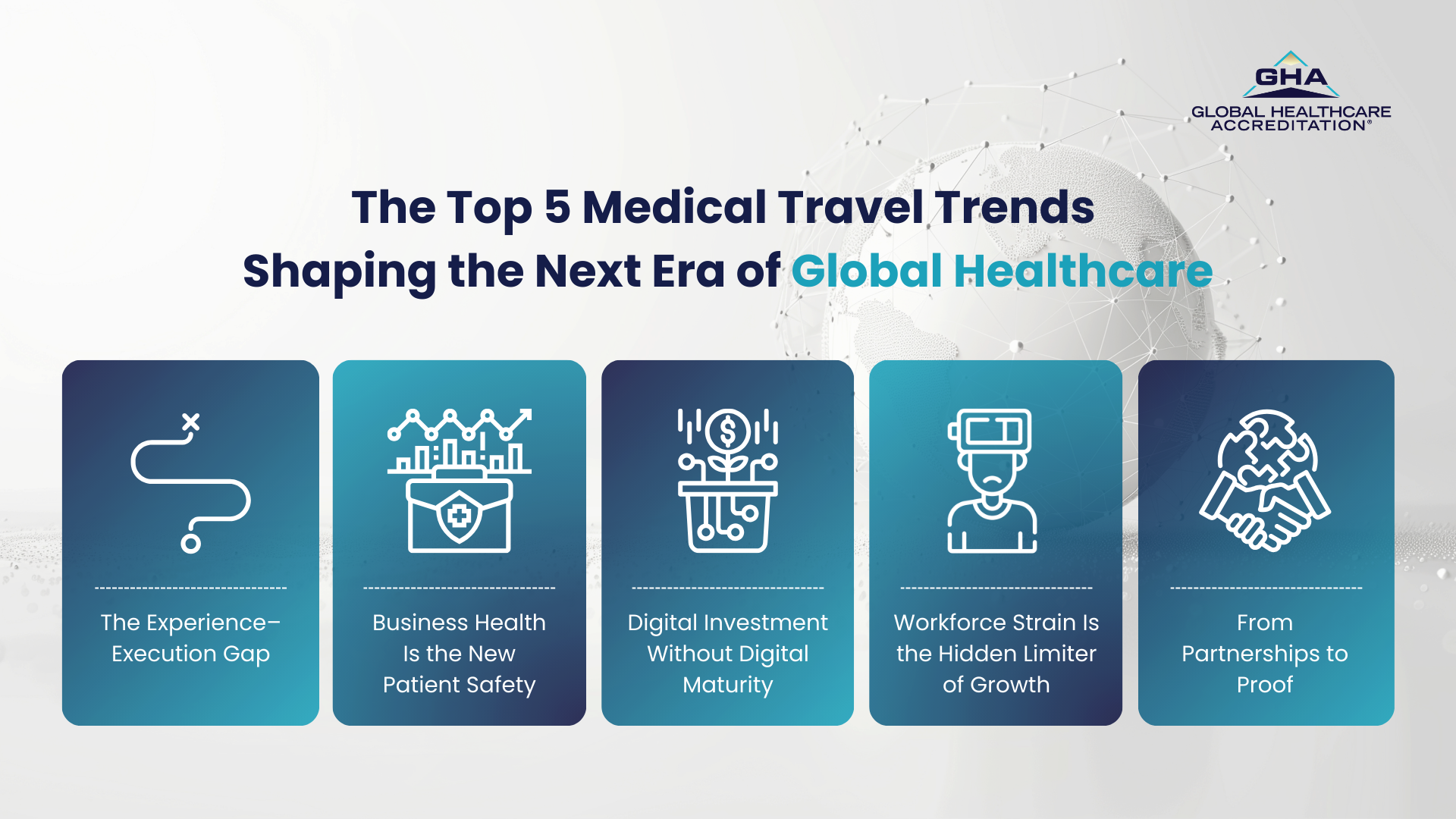
Medical travel is no longer a growth story—it’s an execution story. As cross-border patient volumes rebound and diversify post-pandemic, Global Healthcare Accreditation’s latest benchmarking reveals a clear inflection point: organizations are no longer competing on clinical excellence alone, but on their ability to operationalize the entire international patient journey.
Benchmarking across accredited and evaluated international patient programs shows five structural trends are emerging as the new norm. These trends do not reflect aspirational best practices or speculative predictions. They reflect observable shifts in how international patient programs succeed, where organizations are encountering friction, and where the next global baseline for medical travel is being set.
Trend 1
End-to-End Experience Accountability Is the New Baseline
In medical travel, experience breakdowns rarely occur during clinical care, they occur in the handoffs before arrival, between providers, and after patients return home.
Healthcare organizations frequently promote world-class patient experience for international patients. In practice, experience excellence is often strongest within the clinical encounter itself, while the broader international journey remains fragmented.
GHA’s observations show that pre-arrival coordination, referral intake, financial clarity, travel logistics, and post-return follow-up are often managed inconsistently or across disconnected functions. For international patients, experience is not confined to clinical environments; its pans borders, timelines, and multiple decision points. When accountability ends at the point of care, patients experience gaps that undermine trust and continuity.
What this means:
For healthcare organizations, patient experience must be managed as an end‑to‑end, cross‑border journey rather than as a departmental responsibility or a post‑discharge survey score. Through work with organizations across multiple accreditation cycles, GHA has observed that programs which excel at pre‑arrival coordination, in‑country care delivery, and post‑travel engagement achieve higher conversion rates, fewer operational breakdowns, and greater lifetime patient value. At the destination and health‑system level, competitiveness increasingly depends on system‑wide coordination among providers and partners, rather than on isolated centers of clinical excellence.
Trend 2
Business Health Is Moving Into the Risk and Quality Domain
As international programs scale, weak governance and informal business models are no longer operational inconveniences—they are becoming sources of patient, workforce, and reputational risk.
Medical travel programs rarely struggle because of clinical quality. More often, underperformance stems from weak business foundations.
Benchmarking across accredited and evaluated international patient programs shows gaps in service‑line definition, market prioritization, governance, and performance measurement. While shortcomings appear across each of these areas, deficiencies are most pronounced in governance and performance measurement. In nearly half of programs reviewed, decision rights were unclear, executive accountability was diffuse, and operating authority remained informal. Many medical travel programs exist as initiatives rather than structured operating units, relying on informal processes and limited accountability.
As international volumes grow, these weaknesses introduce operational risk, workforce strain, and reputational exposure.
What this means:
For healthcare providers, medical travel must be managed as a formal business function with defined governance, strategy, and performance oversight. Informal or opportunistic approaches become increasingly unsustainable at scale.
Forboards and executive leadership, business health is no longer separate fromquality or safety; it is a governance issue directly tied to program resilience, credibility, and long-term success.
Trend 3
Digital Integration Is Overtaking Digital Expansion
Medical travel programs are investing heavily in digital tools, yet many are delivering a more fragmented patient experience because those systems are not integrated or governed as a single journey.
GHA benchmarking indicates that in more than 80% of evaluated programs, digital systems operate in functional silos. Telehealth platforms are often disconnected from international care workflows, CRM tools are underutilized, and patient data is fragmented across multiple systems. As a result, technology investments frequently fail to deliver a cohesive, consistent, or reliable international patient experience.
The issue is no longer whether digital tools exist, but whether organizations have achieved digital maturity.
What this means:
For healthcare providers, digital capability will increasingly be judged by integration, governance, and patient usability, not by the number of tools deployed. Organizations that unify digital touchpoints across the international patient journey will gain efficiency, transparency, and trust.
For international patients, digital clarity before arrival and after return is becoming a proxy for organizational competence and reliability.
Trend 4
Workforce Readiness Is Defining Scalability
International patient growth is increasingly limited not by demand or clinical capability, but by workforce readiness, role clarity, and sustainable program design.
In more than half of the programs reviewed, GHA evaluations identify unclear role definitions, limited training specific to international care, overreliance on a small number of experienced individuals, and minimal succession planning. As a result, organizational growth is absorbed by people rather than supported by scalable systems.
Overtime, this strain undermines responsiveness, consistency, and program sustainability.
What this means:
For healthcare providers, sustainable medical travel growth requires professionalized roles, defined competencies, responsibilities, and structured training pathways specific to international patient care. Programs dependent on informal effort or “hero” staff are inherently fragile.
For leadership teams, workforce readiness is a strategic constraint. Organizations that invest early in capability and upskilling are better positioned to scale responsibly.
Trend 5
Performance-Based Partnerships Are Replacing Symbolic Alliances
Global healthcare partnerships are being redefined: affiliations without measurable outcomes are losing credibility with patients, payers, and policymakers alike.
Benchmarking reveals many international affiliations lack clearly defined objectives, operational integration, shared accountability, or measurable outcomes.
As a result, these partnerships often fail to translate into sustained patient referrals or measurable patient volume.
Stakeholders are now demanding evidence, not symbolism.
What this means:
For healthcare providers, partnerships must be designed for execution rather than optics. Clear goals, defined responsibilities, and performance metrics are becoming essential components of credible international collaboration.
For governments, insurers, and employers, partner selection is increasingly drivenby demonstrated outcomes, transparency, and reliability, not affiliation alone.
From Differentiation to Expectation
Taken together, these five trends reflect a fundamental shift in medical travel. What once differentiated leading organizations is rapidly becoming the minimum expectation. Patient experience is expanding into full journey accountability. Business health is emerging as a core risk domain. Digital capability is being measured by integration rather than investment. Workforce readiness is defining scalability. Partnerships are being tested by measurable results.
Medical travel is moving from a growth opportunity to a performance test. Organizations that treat international patients primarily as a volume strategy will struggle to sustain credibility, consistency, and long-term value. Those that approach medical travel as a system—governed, measured, and accountable across the entire cross-border patient journey—will define the next era of global healthcare.
As an accreditation and benchmarking body focused exclusively on medical travel, Global Healthcare Accreditation observes these shifts not as theory, but as patterns emerging across real organizations, real markets, and real patient journeys. The implications are clear: success in the next phase of global healthcare will be determined less by ambition and more by execution.
Organizations that respond early, by aligning governance, systems, workforce, and operational accountability, will help shape evolving expectations and standards. Those that do not, risk operating within a model of medical travel that no longer reflects the realities of international patient care.
Download the Executive Brief
These findings are drawn from Global Healthcare Accreditation’s on going international benchmarking of medical travel programs. Download the deck to understand how medical travel expectations are evolving.


