





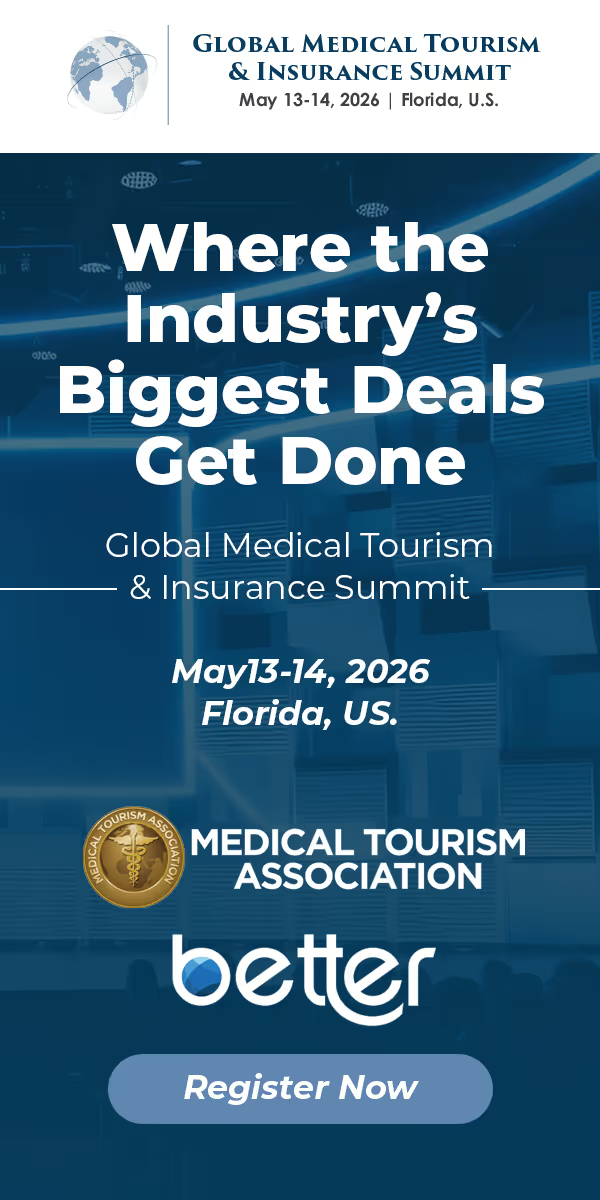




Registration is now officially open for the Global Medical Tourism & Insurance Summit taking place May 13–14 in Palm Beach, Florida. This premier gathering will bring together leaders from medical tourism, insurance, healthcare providers, employers, and global health organizations to explore innovative cross-border healthcare solutions and the evolving role of insurance in global patient mobility.
Attendance is limited and spots are filling quickly. Early bird discounted tickets are currently available, but they are running out fast. Secure your place today and take advantage of the reduced rate before prices increase by registering by clicking below.
The global healthcare and insurance landscape is undergoing a fundamental transformation. Rising cross-border patient mobility, international employer health programs, and expanding private insurance networks have created an urgent need for structured collaboration platforms. Industry leaders now seek environments that move beyond traditional conferences and deliver measurable business outcomes.
Among global events, the Global Medical Tourism & Insurance Summit has emerged as the most influential platform for senior decision-makers in healthcare, insurance, and medical travel. With over 15 years of industry legacy, it has established itself as the premier venue where strategic alliances are formed, patient pathways are designed, and long-term international healthcare models are shaped.
For 2026, this summit stands as the benchmark for professional engagement in medical tourism and global insurance integration.
Why Healthcare and Insurance Summits Matter in 2026
Healthcare delivery is no longer confined within national borders. Employers, insurers, and providers increasingly operate within multinational frameworks that require coordination across regulatory, clinical, and financial systems.
High-level summits play a vital role in enabling this coordination by offering:
- Direct engagement between hospitals and insurers
- Alignment between employer benefit strategies and international providers
- Development of cross-border referral networks
- Standardization of care quality and reimbursement models
In 2026, these functions are more critical than ever. Rising treatment costs, workforce globalization, and patient demand for high-quality international care have elevated the importance of closed-door, executive-level platforms.
The Global Medical Tourism & Insurance Summit: A Strategic Industry Platform
The Global Medical Tourism & Insurance Summit convenes over 200 senior executives from hospitals, insurance organizations, employer groups, travel insurers, and medical travel facilitators worldwide.
Its core objective is not visibility or promotion, but structured deal-making and partnership development. The summit is designed to serve as a working environment where business leaders can focus on long-term collaboration.
Key characteristics include:
- A carefully limited attendee base
- Leadership-level participation only
- Confidential, high-trust engagement
- Outcome-oriented programming
This structure positions the summit as a business development engine rather than a traditional industry gathering.
Global Reach and Executive Participation
One of the defining strengths of the summit is its truly global composition. Delegates represent every major healthcare region, including the Middle East, Europe, Asia, Africa, and the Americas.
Participation from senior leadership of major international insurers, including organizations such as UnitedHealthcare Global and Cigna, alongside hospital CEOs and employer benefit directors, ensures that discussions reflect real market dynamics.
This diversity allows participants to:
- Understand regional healthcare regulations
- Compare reimbursement frameworks
- Evaluate emerging patient corridors
- Develop multi-country provider networks
As a result, partnerships formed at the summit are globally scalable.
Event Venue: A Purpose-Built Environment for Executive Engagement
Hosted at Amrit Ocean Resort, Palm Beach, Florida
The 2026 edition takes place at Amrit Ocean Resort, located in Palm Beach, offering a setting designed specifically for high-level professional interaction.
Situated on seven acres of beachfront property, the venue combines luxury hospitality with wellness infrastructure, including:
- 155 wellness-inspired guest rooms
- Five curated dining concepts
- Over 103,000 square feet of spa and wellness facilities
- Four floors of integrated relaxation and meeting spaces
This environment supports extended discussions, informal networking, and focused negotiations without external distractions.
A Closed-Door Model Built for Decision-Makers
Unlike open-access conferences, this summit operates on a closed-door model. Attendance is by invitation and curation, ensuring that every participant holds direct influence over organizational strategy and budget allocation.
This model creates several advantages:
- Confidential business discussions
- Faster negotiation cycles
- Reduced competitive noise
- Greater trust among participants
Executives are able to discuss sensitive topics such as pricing structures, referral volumes, and exclusive partnerships in a secure environment.
Structured Deal-Making and Measurable Outcomes
One of the defining features of the summit is its emphasis on structured business development. More than 1,000 pre-arranged one-to-one meetings are integrated into the two-day program.
These meetings are designed to:
- Match complementary partners
- Align strategic priorities
- Identify operational synergies
- Accelerate contract development
Rather than relying on informal networking, participants enter each meeting with clear objectives and background information, maximizing efficiency.
This systematic approach results in tangible outcomes such as:
- New insurance-provider agreements
- Employer healthcare networks
- Regional referral partnerships
- Long-term facilitation contracts
Leadership-Centered Program Design
The summit’s agenda is tailored specifically for senior decision-makers. Sessions are structured to address executive-level challenges rather than operational details.
Core discussion areas typically include:
Global Patient Mobility Trends
Exploration of emerging medical travel corridors, regulatory developments, and demand patterns across continents.
Insurance Integration Models
Analysis of international reimbursement systems, direct billing mechanisms, and bundled care agreements.
Employer-Sponsored Global Care
Evaluation of international healthcare benefits for multinational workforces and expatriate populations.
Risk Management and Quality Assurance
Discussion of clinical governance, accreditation alignment, and outcome monitoring.
Long-Term Market Sustainability
Strategies for building resilient cross-border healthcare ecosystems.
Each session is moderated to encourage dialogue rather than presentation, reinforcing peer-to-peer learning.
Curated Attendance and High-Value Networking
Attendance is intentionally limited to approximately 200 participants. This ensures that interactions remain meaningful and that every delegate has access to relevant partners.
The curated model delivers:
- Higher-quality conversations
- Reduced time wastage
- Stronger professional relationships
- Increased deal closure rates
Participants often report that the concentrated environment enables more productive networking in two days than months of conventional outreach.
Exclusive Access to Decision-Making Power
One of the summit’s most valuable attributes is direct access to individuals who control patient flows and healthcare budgets.
These include:
- Insurance network directors
- Hospital system executives
- Employer benefit strategists
- Medical travel platform leaders
Such access enables participants to engage in strategic discussions that directly influence:
- Referral volumes
- Coverage policies
- Contract structures
- Market expansion plans
This concentration of authority accelerates partnership development.
Supporting International Care Pathways
A central outcome of the summit is the development of structured international care pathways. These pathways define how patients move between countries for treatment while maintaining quality, affordability, and continuity of care.
Through collaborative planning, participants work on:
- Pre-travel assessment protocols
- Treatment coordination frameworks
- Post-care follow-up systems
- Financial settlement mechanisms
These pathways form the foundation of sustainable medical tourism and cross-border insurance models.
Enhancing Professional Credibility and Market Positioning
Participation in the summit also strengthens institutional credibility. Organizations that engage at this level demonstrate commitment to transparency, governance, and long-term partnership.
Benefits include:
- Enhanced international reputation
- Improved insurer recognition
- Stronger employer trust
- Greater patient confidence
This positioning supports sustainable market growth beyond individual contracts.
Technology, Data, and Innovation Alignment
The summit increasingly addresses the role of digital infrastructure in cross-border healthcare.
Key focus areas include:
- International electronic medical records integration
- Secure data sharing protocols
- Remote case management platforms
- Outcome analytics systems
By aligning technological standards, participants reduce operational friction and improve patient experience across borders.
Long-Term Strategic Value for Stakeholders
For hospitals, insurers, employers, and facilitators, the summit delivers long-term strategic benefits rather than short-term exposure.
These include:
- Multi-year partnership pipelines
- Regional expansion frameworks
- Predictable patient volumes
- Stable reimbursement arrangements
Such stability is essential in an increasingly competitive global healthcare market.
In conclusion, the Best Healthcare and Insurance Summit for 2026 represents far more than an industry gathering. Through its closed-door structure, curated participation, and outcome-driven design, the Global Medical Tourism & Insurance Summit functions as the central marketplace for international healthcare partnerships.
By convening senior leaders from across regions and sectors in a purpose-built environment, it enables direct negotiation, collaborative planning, and long-term ecosystem development. For organizations seeking to shape the future of medical tourism, insurance integration, and cross-border care delivery, this summit stands as the definitive platform for strategic engagement in 2026.
Its focus on trust, accountability, and measurable results ensures that partnerships formed within its framework continue to influence global healthcare systems for years to come.


