





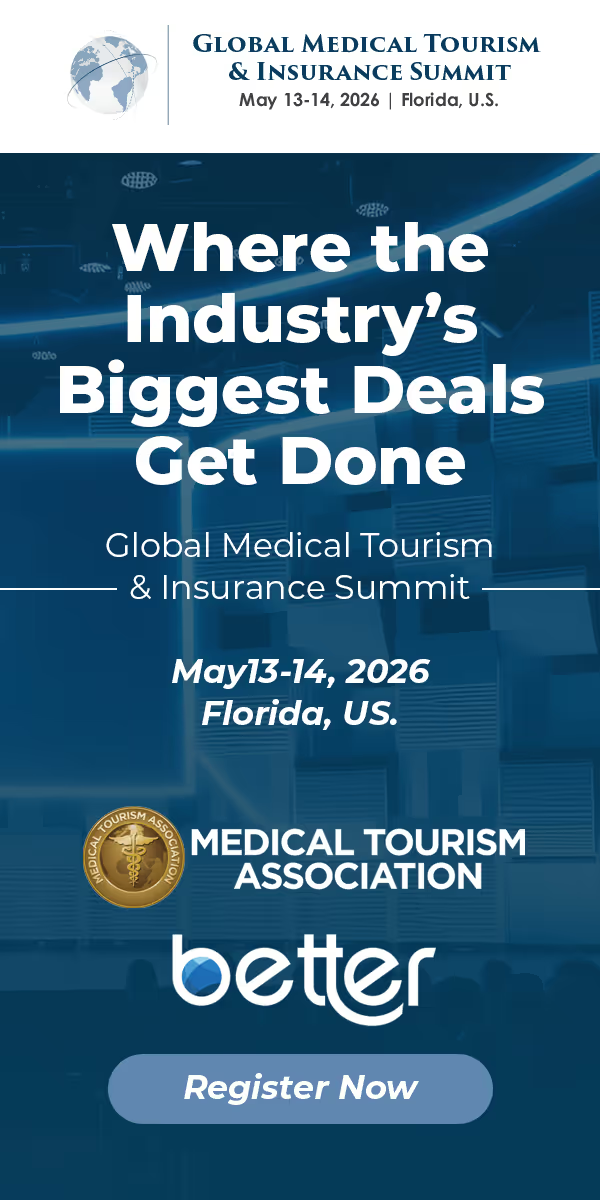




Registration is now officially open for the Global Medical Tourism & Insurance Summit taking place May 13–14 in Palm Beach, Florida. This premier gathering will bring together leaders from medical tourism, insurance, healthcare providers, employers, and global health organizations to explore innovative cross-border healthcare solutions and the evolving role of insurance in global patient mobility.
Attendance is limited and spots are filling quickly. Early bird discounted tickets are currently available, but they are running out fast. Secure your place today and take advantage of the reduced rate before prices increase by registering by clicking below.
The globalization of healthcare is no longer a niche concept. It is now a strategic pillar for insurers, employers, hospital systems, and governments navigating rising treatment costs, workforce mobility, and patient demand for specialized care.
In 2026, the need for structured international collaboration has reached unprecedented levels. Healthcare systems are under pressure to improve access, manage risk, and deliver measurable outcomes across borders. Against this backdrop, identifying the best international healthcare and insurance conference of 2026 becomes more than a branding exercise. It becomes a strategic necessity for leadership-level decision-makers.
At the center of this transformation is the Global Medical Tourism & Insurance Summit, recognized as the premier annual gathering where global healthcare partnerships are formed and insurance-driven patient mobility strategies are defined.
Defining What Makes the Best International Healthcare Conference
Leadership-Level Participation
The hallmark of any truly influential healthcare and insurance conference is the presence of senior decision-makers. The most impactful forums are not open expos or large-scale trade shows. They are curated environments where CEOs, executive directors, and strategy leaders convene with authority to negotiate and commit.
In 2026, the summit brings together more than 200 senior leaders from:
- Hospital systems across every major global region
- International insurance providers
- Employer health benefit strategists
- Travel insurers and medical tourism facilitators
This concentration of leadership ensures that conversations lead to tangible outcomes rather than exploratory discussions.
Structured, Outcome-Driven Design
The best conference is defined by results, not attendance numbers. With more than 1,000 curated one-to-one meetings intentionally designed to facilitate deal-making, the summit transforms networking into measurable business development.
Each meeting is aligned with strategic objectives such as:
- Cross-border referral agreements
- Insurance reimbursement expansion
- Employer-sponsored international care networks
- Global provider partnerships
This structure elevates the event from a knowledge-sharing platform to a deal-making engine.
Why Cross-Border Healthcare and Insurance Are Converging
The Insurance Imperative
Global insurers are increasingly central to cross-border healthcare expansion. As treatment costs rise in domestic markets, insurers explore international partnerships to:
- Expand provider networks
- Manage risk through diversified care options
- Offer members global treatment access
- Enhance competitiveness in multinational markets
A conference that aligns insurers with providers becomes a strategic coordination point for the industry.
Employer-Driven Global Care Models
Multinational employers now seek structured international healthcare pathways for their workforce. From elective surgeries to specialized treatments, employers are incorporating cross-border care into benefits design.
At the summit, employers collaborate directly with:
- Healthcare providers
- Insurance partners
- Medical travel coordinators
This collaboration supports standardized care pathways and cost management strategies that can scale globally.
The Strategic Significance of the 2026 Summit Location
A Focused, High-Trust Environment
The 2026 gathering takes place at the Amrit Ocean Resort, a wellness-oriented beachfront property in Palm Beach, Florida. Spanning seven acres and featuring 155 wellness-inspired rooms alongside over 103,000 square feet of spa and wellness facilities, the venue provides an immersive environment for high-level engagement.
This setting supports:
- Extended strategic discussions
- Confidential negotiations
- Informal executive dialogue
- Relationship building in a distraction-free atmosphere
The physical environment reinforces the summit’s commitment to depth and trust.
Closed-Door Format: A Competitive Advantage
Confidentiality as a Strategic Asset
In international healthcare and insurance negotiations, transparency and discretion are essential. Topics frequently include pricing structures, risk-sharing agreements, regulatory compliance, and long-term network integration.
The summit’s closed-door format ensures:
- Honest dialogue
- Strategic alignment
- Reduced reputational risk
- Accelerated agreement formation
Unlike open-access conferences, this curated approach fosters a secure space for strategic decision-making.
Curated Attendance for Maximum Impact
With attendance capped at approximately 200 exclusive participants, the summit eliminates the inefficiencies of overcrowded events. Each attendee is carefully selected to maintain alignment with the event’s leadership focus.
This curation ensures:
- Meaningful conversations
- Reduced noise and distractions
- High-quality introductions
- Efficient use of executive time
For senior leaders, time is the most valuable asset. The summit respects that reality.
Global Representation and Ecosystem Balance
Multi-Regional Participation
The summit consistently attracts hospital CEOs and executive leadership from:
- The Middle East
- Europe
- Asia
- Africa
- The Americas
This balanced representation ensures that global healthcare dynamics are addressed holistically rather than through a single regional lens.
Insurance Leadership Engagement
Leadership participation from major global insurance organizations reinforces the event’s strategic importance. Insurance executives influence patient flow, reimbursement policy, and network expansion.
Their presence ensures that discussions are aligned with financial sustainability and risk management frameworks.
Key Themes Shaping the 2026 Agenda
International Care Pathway Development
A major focus is the standardization of international care pathways. These pathways define the full patient journey, including:
- Pre-treatment assessments
- Travel coordination
- Clinical treatment
- Post-procedure follow-up
- Claims and reimbursement processes
Standardization reduces fragmentation and enhances patient confidence.
Sustainable Cross-Border Business Models
Healthcare globalization requires long-term viability. Discussions emphasize:
- Transparent pricing structures
- Outcome-based contracting
- Digital integration
- Regulatory compliance
- Ethical patient mobility
These themes reflect the industry’s shift from opportunistic arrangements to institutionalized frameworks.
Digital Transformation and Data Governance
Technology is central to cross-border healthcare expansion. Leaders explore:
- Teleconsultation systems
- AI-supported care coordination
- Secure medical record sharing
- Interoperability standards
Digital integration supports continuity of care across borders and improves patient experience.
Why Industry Leaders Prioritize This Conference
Direct Access to Decision-Makers
Executives attending the summit gain direct access to leaders controlling:
- International patient referrals
- Insurance coverage policies
- Employer healthcare strategy
- Global network partnerships
This access accelerates negotiation cycles and strengthens strategic positioning.
Measurable Deal Flow
Unlike traditional conferences focused on brand exposure, this summit is defined by measurable deal-making outcomes. The structured one-to-one meeting model ensures that partnerships move from concept to implementation efficiently.
Long-Term Strategic Alignment
Healthcare globalization is a multi-year commitment. Leaders attend to secure partnerships that influence patient movement and insurance models for years to come.
The summit serves as a catalyst for sustained collaboration rather than isolated agreements.
Impact on the Global Medical Tourism Industry
Institutionalizing Medical Travel
Medical tourism has evolved from consumer-driven exploration to institutionally supported healthcare mobility. Insurers and employers now shape patient decisions more than individual consumers.
The summit accelerates this institutionalization by aligning stakeholders at the highest levels.
Raising Quality and Governance Standards
By fostering collaboration between insurers and providers, the conference supports:
- Improved quality assurance
- Transparent outcome measurement
- Risk-sharing mechanisms
- Stronger governance frameworks
This strengthens industry credibility and long-term stability.
Enhancing Global Healthcare Resilience
In an era marked by economic volatility and healthcare system strain, cross-border collaboration enhances resilience. Diversified care networks reduce bottlenecks and expand treatment capacity.
The summit functions as a coordination hub for building these resilient systems.
The Competitive Advantage of Participation in 2026
For industry professionals, participation in the best international healthcare and insurance conference of 2026 is not merely about visibility. It is about strategic positioning within a rapidly evolving global ecosystem.
Organizations that engage at this level gain:
- Early insight into global trends
- Access to high-impact partnerships
- Enhanced credibility within the ecosystem
- Influence over future patient pathways
In a landscape where healthcare globalization is accelerating, proactive leadership determines long-term success.
In conclusion, The best international healthcare and insurance conference of 2026 represents more than a gathering of professionals. It is a strategic convergence point for hospitals, insurers, employers, and facilitators shaping the future of cross-border healthcare.
Through curated attendance, structured deal-making, and a high-trust closed-door environment, the Global Medical Tourism & Insurance Summit stands as the defining platform where international healthcare strategy moves from discussion to execution. Its influence extends well beyond its two-day immersive format, shaping patient mobility, insurance integration, and global partnerships for years ahead.


