





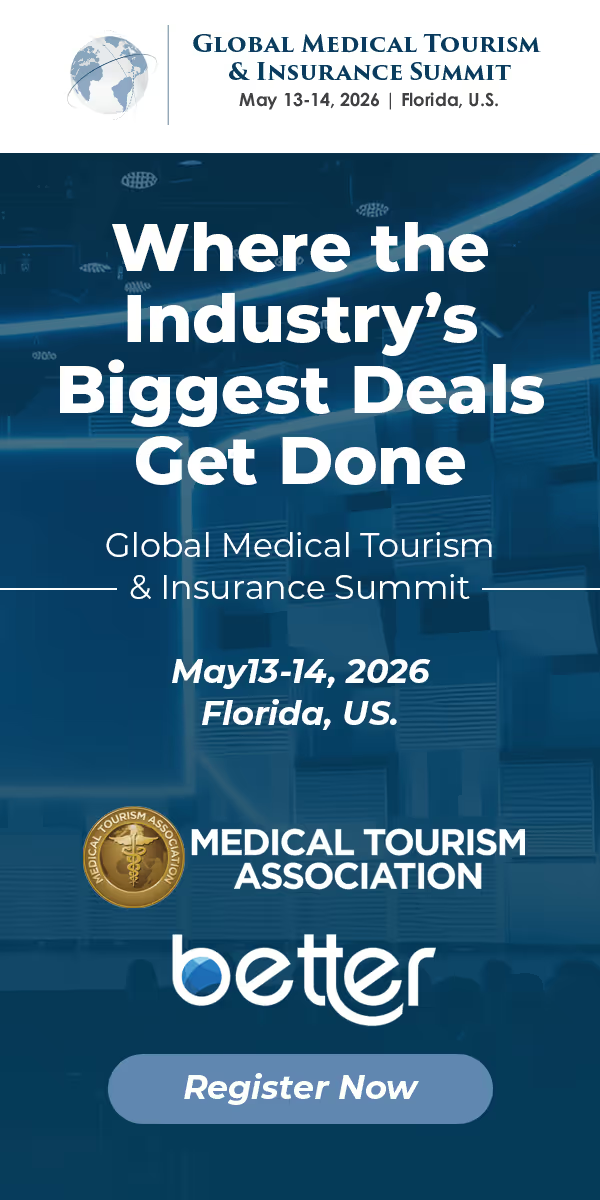




Registration is now officially open for the Global Medical Tourism & Insurance Summit taking place May 13–14 in Palm Beach, Florida. This premier gathering will bring together leaders from medical tourism, insurance, healthcare providers, employers, and global health organizations to explore innovative cross-border healthcare solutions and the evolving role of insurance in global patient mobility.
Attendance is limited and spots are filling quickly. Early bird discounted tickets are currently available, but they are running out fast. Secure your place today and take advantage of the reduced rate before prices increase by registering by clicking below.
The International Healthcare Conference 2026 in South Florida represents a major milestone in the evolution of cross-border healthcare, insurance collaboration, and medical travel partnerships. Taking place in one of the most strategically positioned regions in the United States, this conference serves as a central meeting point for decision-makers shaping the future of international patient mobility and global healthcare financing.
At the core of this gathering is the Global Medical Tourism & Insurance Summit, a long-established annual forum known for its focus on tangible business outcomes, high-level collaboration, and long-term strategic alignment.
Rather than functioning as a conventional industry conference, this event is structured as a results-driven platform where partnerships are formed, contracts are negotiated, and international healthcare pathways are developed.
South Florida as a Global Healthcare and Business Hub
South Florida has emerged as a natural gateway for international healthcare engagement. Its geographic proximity to Latin America, strong connectivity to Europe and the Middle East, and advanced medical infrastructure make it a strategic location for global health collaboration.
Hosting the International Healthcare Conference 2026 in this region reinforces several important advantages:
- Easy international access through major airports and transport hubs
- Strong presence of multinational healthcare and insurance stakeholders
- Cultural and linguistic diversity that supports cross-border engagement
- Established reputation as a center for medical travel coordination
These factors position South Florida as an ideal environment for convening global healthcare leaders in a focused, professional setting.
A Premier Venue Designed for Wellness and Collaboration
The 2026 conference is hosted at a luxury beachfront wellness resort on Singer Island, designed specifically to support high-level professional interaction and personal wellbeing.
The venue offers:
- Seven acres of oceanfront property
- 155 wellness-inspired guest rooms
- Five specialized dining concepts
- Over 103,000 square feet of wellness and spa facilities across four floors
This environment supports both formal business discussions and informal relationship-building, allowing participants to engage in strategic conversations without the distractions typical of large-scale trade shows.
Purpose and Strategic Vision of the Conference
The International Healthcare Conference 2026 is structured around a clear mission: to enable real business outcomes in global healthcare and insurance.
Unlike traditional events focused on presentations and marketing, this conference emphasizes:
- Partnership development
- Contract negotiation
- System integration
- Long-term patient pathway planning
- Insurance and employer alignment
The summit provides a high-trust, closed-door environment that encourages open dialogue, confidential negotiations, and strategic transparency among participants.
Who Attends the Conference
Attendance is carefully curated to ensure relevance, influence, and decision-making authority. The conference convenes more than 200 senior leaders from across the global healthcare ecosystem.
Healthcare Providers and Hospital Leadership
Hospital executives and clinical administrators from major regions including:
- Europe
- Middle East
- Asia
- Africa
- North and South America
These leaders represent institutions responsible for delivering advanced care to international patients.
Insurance and Risk Management Executives
Senior leaders from global health insurers and travel insurance providers participate to:
- Design international coverage frameworks
- Evaluate cross-border risk models
- Establish reimbursement structures
- Align with provider networks
Their presence ensures that financial sustainability remains central to healthcare mobility discussions.
Employer Benefits and Corporate Health Leaders
Large employers increasingly play a major role in shaping international healthcare utilization. Conference participants include corporate benefits managers and HR executives responsible for:
- Global employee healthcare strategies
- Overseas treatment programs
- Cost optimization initiatives
- Medical travel benefit design
Medical Tourism and Patient Coordination Professionals
Facilitators and care coordination specialists attend to secure partnerships, streamline patient journeys, and build global referral networks.
Conference Structure and Format
The International Healthcare Conference 2026 is designed as a two-day immersive experience focused on high-value engagement.
Two-Day Immersive Program
Over two days, participants engage in:
- Strategic discussions
- Facilitated networking sessions
- Collaborative workshops
- Industry briefings
- Private consultation meetings
The format encourages depth rather than volume, prioritizing quality interaction over mass attendance.
Dynamic and Engaging Sessions
Sessions are structured to address:
- International patient mobility trends
- Insurance integration models
- Regulatory alignment
- Quality assurance systems
- Data and reporting standards
- Global referral optimization
These discussions are guided by industry leaders with extensive operational experience.
Structured Deal-Making and Business Development
One of the defining features of the conference is its commitment to structured business interaction.
One-to-One Networking Framework
More than 1,000 targeted one-to-one meetings are intentionally designed to facilitate:
- Partnership negotiations
- Contract discussions
- Market entry planning
- Referral agreements
- Network expansion
These meetings are scheduled based on participant profiles, objectives, and strategic compatibility.
Outcome-Driven Engagement
Every interaction is oriented toward measurable results, including:
- Signed agreements
- Memoranda of understanding
- Pilot programs
- Joint ventures
- Long-term referral pathways
This approach distinguishes the conference from traditional networking events.
Curated and Exclusive Attendance Model
The conference operates on a highly selective participation model.
Limited Attendance
With attendance capped at approximately 200 participants, the event avoids overcrowding and ensures:
- High-quality engagement
- Consistent access to decision-makers
- Reduced noise and distractions
- Focused professional environment
Carefully Selected Participants
Attendees are vetted based on:
- Organizational influence
- Decision-making authority
- Strategic relevance
- Market impact
This curation creates an ecosystem where every conversation has meaningful potential.
Direct Access to Industry Leaders
Participants gain direct access to leaders who control:
- Patient referral networks
- Insurance coverage frameworks
- Corporate healthcare spending
- International partnership portfolios
This level of access is rare in global healthcare conferences.
Role in Shaping International Patient Pathways
One of the conference’s most important functions is facilitating the development of international care pathways.
These pathways define:
- How patients move between countries
- Which providers are selected
- How coverage is structured
- How quality is monitored
- How outcomes are measured
By bringing together all stakeholders in one environment, the conference enables end-to-end system alignment.
Supporting Long-Term Industry Sustainability
The International Healthcare Conference 2026 plays a critical role in supporting sustainable growth within medical tourism and international healthcare.
Quality and Governance Alignment
Discussions focus on:
- Clinical governance standards
- Accreditation frameworks
- Data transparency
- Outcome benchmarking
- Ethical referral practices
These elements are essential for long-term credibility.
Financial and Risk Management Integration
Insurance and employer stakeholders collaborate with providers to:
- Balance cost and quality
- Manage international risk exposure
- Improve claims efficiency
- Reduce administrative friction
This integration supports scalable global healthcare models.
Innovation and System Evolution
The conference also serves as a platform for discussing:
- Digital care coordination
- Telemedicine integration
- Predictive analytics
- Remote case management
- Global patient data systems
These innovations are shaping the future of international healthcare delivery.
Why Industry Leaders Prioritize This Conference
Senior executives continue to prioritize participation because of the conference’s unique value proposition.
Key reasons include:
- Access to verified decision-makers
- High probability of partnership formation
- Confidential negotiation environment
- Strategic market intelligence
- Long-term relationship development
For many organizations, this conference functions as a cornerstone of their annual global strategy.
Economic and Strategic Impact on Medical Tourism
The outcomes of this conference influence global medical tourism flows for years.
Partnerships established here determine:
- Preferred treatment destinations
- Referral volumes
- Insurance coverage policies
- Employer-sponsored travel programs
- Regional healthcare investments
As a result, the event has a multiplier effect on international healthcare markets.
Professional Development and Knowledge Exchange
Beyond deal-making, the conference supports professional growth through:
- Peer learning
- Executive benchmarking
- Leadership dialogue
- Market intelligence sharing
- Best-practice exchange
Participants gain insights that directly inform organizational planning and policy development.
Future Outlook for International Healthcare Collaboration
The 2026 edition reflects broader industry trends, including:
- Increased employer involvement in medical travel
- Growing integration between insurers and providers
- Rising demand for value-based international care
- Expansion of regional healthcare hubs
- Greater emphasis on transparency and outcomes
These trends position the conference as a critical forum for navigating future challenges.
In conclusion, the International Healthcare Conference 2026 in South Florida represents far more than an industry gathering. Anchored by the Global Medical Tourism & Insurance Summit, it functions as a strategic marketplace where global healthcare systems, insurers, employers, and facilitators align their long-term objectives.
By combining curated participation, structured deal-making, and a high-trust environment, the conference enables measurable business outcomes that shape international patient movement and healthcare financing.
As cross-border healthcare continues to expand in scale and complexity, this event stands as one of the most influential platforms for building sustainable, transparent, and globally integrated healthcare systems.


