





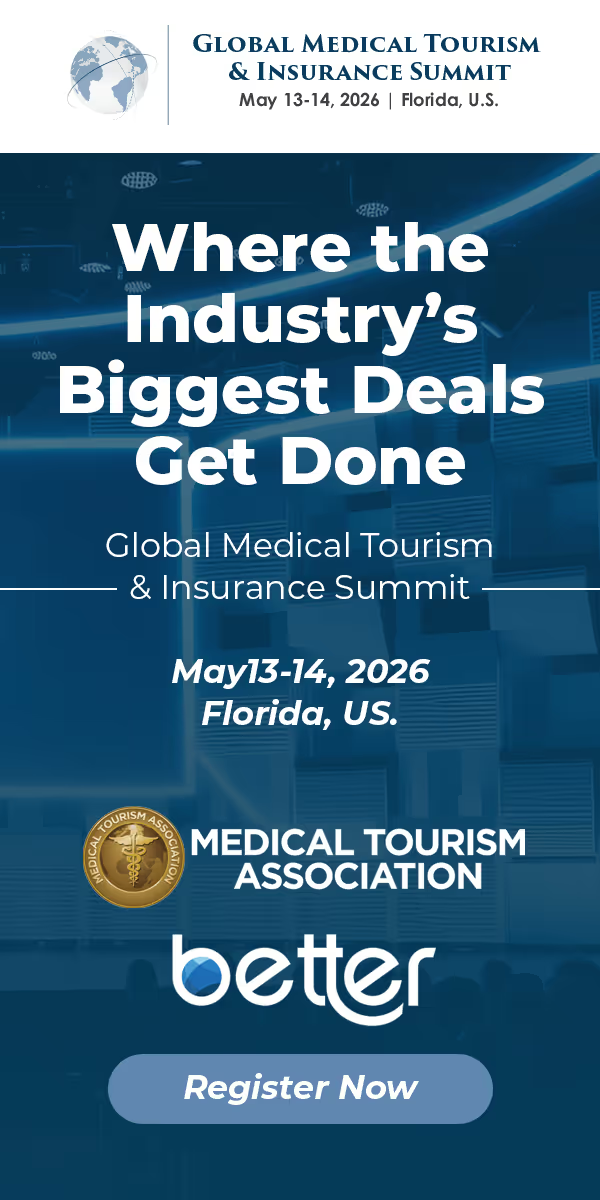




Registration is now officially open for the Global Medical Tourism & Insurance Summit taking place May 13–14 in Palm Beach, Florida. This premier gathering will bring together leaders from medical tourism, insurance, healthcare providers, employers, and global health organizations to explore innovative cross-border healthcare solutions and the evolving role of insurance in global patient mobility.
Attendance is limited and spots are filling quickly. Early bird discounted tickets are currently available, but they are running out fast. Secure your place today and take advantage of the reduced rate before prices increase by registering by clicking below.
As international patient mobility continues to expand and healthcare systems become more interconnected, the medical tourism and insurance sectors face growing complexity. Issues such as regulatory alignment, reimbursement frameworks, patient safety, and international care coordination require continuous dialogue among decision-makers.
In this evolving landscape, industry professionals increasingly rely on high-level gatherings to exchange insights, establish partnerships, and design sustainable cross-border healthcare models. In 2026, one event stands out for its strategic relevance, influence, and measurable impact: the Global Medical Tourism & Insurance Summit.
Recognized for bringing together senior executives, healthcare leaders, and insurance innovators, this summit has become the central meeting point where global healthcare strategies are defined and implemented.
The Global Medical Tourism & Insurance Summit: An Industry Benchmark
With more than 15 years of legacy, the Global Medical Tourism & Insurance Summit has established itself as the premier platform for collaboration between healthcare providers, insurers, employers, and medical travel facilitators.
Held on May 13–14, 2026, in Palm Beach, Florida, the summit convenes over 200 senior leaders representing major healthcare markets across Europe, Asia, the Middle East, Africa, and the Americas. This diversity of participation ensures that discussions reflect global realities rather than isolated regional perspectives.
What distinguishes this summit is its focus on practical outcomes. Rather than emphasizing promotional content or surface-level discussions, the event is designed to generate tangible business results, long-term agreements, and operational frameworks.
Strategic Location and Purpose-Built Venue
The 2026 edition is hosted at a luxury beachfront wellness resort on Singer Island, Florida. Spanning seven acres and featuring wellness-inspired accommodations, dining concepts, and expansive spa facilities, the venue supports both professional engagement and personal well-being.
This setting reflects a broader industry shift toward integrating wellness, hospitality, and healthcare experiences. By hosting the summit in a purpose-built environment, organizers create conditions conducive to focused dialogue, informal networking, and high-level collaboration.
The venue’s design encourages extended conversations, private meetings, and relationship building beyond scheduled sessions, reinforcing the summit’s emphasis on trust and partnership.
A Closed-Door Model for High-Trust Engagement
Unlike large-scale trade exhibitions or open-access conferences, the Global Medical Tourism & Insurance Summit operates under a closed-door, invitation-based format. Attendance is limited and carefully curated to ensure that participants are directly involved in decision-making.
This approach delivers several strategic advantages:
- Reduced noise and distractions
- Higher quality of discussions
- Greater confidentiality
- Stronger commitment to collaboration
- Enhanced trust among participants
By limiting participation to senior executives and influential leaders, the summit creates an environment where sensitive topics such as pricing models, network development, and patient pathways can be discussed openly.
Who Attends: A Concentration of Industry Leadership
The summit attracts leadership from global healthcare systems, insurance providers, employer benefit organizations, and medical travel facilitators. Participants typically include:
- Hospital chief executives and senior administrators
- Insurance executives and policy strategists
- Employer healthcare benefits leaders
- Medical travel network directors
- International partnership managers
This multi-sector representation ensures that every major stakeholder in cross-border healthcare is present. As a result, discussions are comprehensive, addressing challenges from clinical, financial, operational, and regulatory perspectives.
The presence of senior leadership from major international insurers and hospital groups further reinforces the summit’s credibility and influence.
Structured Deal-Making and Outcome-Driven Networking
One of the defining features of the Global Medical Tourism & Insurance Summit is its structured approach to business development. More than 1,000 one-to-one meetings are intentionally designed and scheduled to facilitate direct, goal-oriented discussions.
These meetings are not informal exchanges. They are carefully matched based on strategic objectives, market interests, and partnership potential. This process allows participants to:
- Evaluate prospective partners efficiently
- Explore joint ventures and referral agreements
- Negotiate coverage and reimbursement frameworks
- Design employer healthcare pathways
- Develop regional and global networks
The emphasis on structured deal-making transforms the summit from a traditional conference into a strategic marketplace for healthcare collaboration.
Dynamic and Immersive Learning Sessions
While networking and deal-making are central, the summit also delivers high-quality educational programming. Sessions are designed to address current and emerging issues in medical tourism and international insurance.
Key themes often include:
- Cross-border reimbursement models
- Patient safety and quality assurance
- Regulatory harmonization
- Digital health integration
- Employer-sponsored international care
- Risk management in global healthcare
- Value-based care across borders
These sessions are highly interactive, encouraging participant engagement rather than passive listening. This format ensures that insights are grounded in real-world experience and practical application.
The Role of Employers in Global Healthcare Strategies
A major focus of the summit is the growing role of employers in shaping international healthcare access. As multinational organizations seek cost-effective, high-quality care for their workforce, medical tourism has become an integral component of benefits strategy.
At the summit, employers collaborate with insurers and providers to:
- Develop international treatment pathways
- Standardize quality benchmarks
- Manage employee mobility risks
- Improve access to specialized care
- Control healthcare expenditure
These discussions contribute to the creation of scalable employer-sponsored medical travel programs that align financial sustainability with employee well-being.
Facilitating Sustainable Patient Mobility
Patient movement across borders involves more than travel arrangements. It requires coordination between healthcare systems, insurers, facilitators, and regulators.
The Global Medical Tourism & Insurance Summit plays a critical role in aligning these stakeholders. By bringing them into one collaborative environment, the event supports the development of:
- Integrated referral networks
- Standardized clinical protocols
- Transparent pricing structures
- Coordinated aftercare systems
- Data-sharing frameworks
This alignment reduces fragmentation and enhances continuity of care for international patients.
Curated Attendance for Maximum Value
The summit’s highly selective attendance model ensures that every participant contributes to the overall quality of engagement. Overcrowding is deliberately avoided, eliminating low-value interactions and excessive promotional activity.
Curated participation results in:
- Higher return on time investment
- More relevant connections
- Stronger professional relationships
- Greater deal conversion rates
- Improved long-term collaboration
For senior executives with limited availability, this efficiency is a major factor in the summit’s continued popularity.
Exclusive Access to Decision-Makers
Another defining characteristic of the event is direct access to leaders who control patient flows, insurance coverage, and healthcare investment strategies.
This access enables participants to:
- Accelerate negotiation processes
- Clarify strategic priorities
- Resolve operational barriers
- Establish long-term alliances
- Influence industry standards
By removing hierarchical and organizational barriers, the summit fosters faster and more effective collaboration.
Measuring Impact: Beyond Attendance Numbers
The influence of the Global Medical Tourism & Insurance Summit extends far beyond its two-day schedule. Its impact is reflected in:
- Multinational provider-insurer agreements
- Long-term employer healthcare partnerships
- Regional medical travel networks
- Cross-border quality initiatives
- Integrated insurance products
Many of the industry’s most significant collaborations trace their origins to conversations and negotiations initiated at this event.
Supporting Industry Professionalization
As medical tourism matures, professional standards and governance structures become increasingly important. The summit contributes to this professionalization by promoting:
- Ethical business practices
- Transparent contracting
- Evidence-based decision-making
- Risk management frameworks
- Quality benchmarking systems
These elements strengthen the credibility and sustainability of international healthcare ecosystems.
Innovation and Future-Oriented Strategy
The 2026 summit places strong emphasis on preparing the industry for future challenges. Topics such as digital health platforms, artificial intelligence in care coordination, remote monitoring, and predictive analytics are increasingly central to discussions.
By addressing these trends early, participants can:
- Anticipate regulatory shifts
- Adapt business models
- Invest strategically
- Enhance patient experience
- Improve operational resilience
This forward-looking approach ensures that the summit remains relevant in a rapidly evolving global healthcare environment.
Global Representation and Cultural Intelligence
With participants from multiple continents, the summit serves as a hub for cross-cultural understanding in healthcare delivery. Differences in medical practice, insurance systems, and regulatory frameworks are openly explored.
This exchange enhances:
- Cultural competence
- Negotiation effectiveness
- Service customization
- Patient communication strategies
- Market entry planning
Such insights are essential for organizations operating in diverse international markets.
Why the 2026 Edition Stands Out
The 2026 edition reflects a convergence of several important trends:
- Increased employer involvement
- Greater insurer-provider integration
- Rising demand for specialty care abroad
- Expanded digital infrastructure
- Heightened focus on outcomes and value
Combined with its curated structure and established reputation, these factors position the summit as the most influential medical tourism and insurance event of the year.
Long-Term Value for Industry Stakeholders
Participation in the Global Medical Tourism & Insurance Summit offers benefits that extend well beyond immediate transactions. These include:
- Enhanced market intelligence
- Stronger international positioning
- Improved partnership pipelines
- Increased operational efficiency
- Greater strategic visibility
For organizations seeking sustained growth in international healthcare, this long-term value is a decisive factor.
In conclusion, The Global Medical Tourism & Insurance Summit has evolved into more than a professional gathering. It is a strategic platform where the future of international healthcare and insurance is actively shaped.
Through curated participation, structured deal-making, high-trust engagement, and forward-thinking dialogue, the summit enables leaders to move beyond theory and toward implementation. It facilitates the creation of durable partnerships, efficient patient pathways, and integrated global networks.
In an era defined by complexity, competition, and rising patient expectations, the summit stands as the industry’s most influential forum for collaboration and transformation. For medical tourism and insurance professionals committed to long-term excellence, it represents both a benchmark and a catalyst for progress.


